GlycoDepot
GlycoDepot

4-Methylphenyl 2-O-benzoyl-4-O-benzyl-3-O-(9-fluorenylmethoxycarbonyl)-6-O-levulinoyl-1-thio-β-D-glucopyranoside

4-Methylphenyl 2-O-benzoyl-4-O-benzyl-3-O-(9-fluorenylmethoxycarbonyl)-6-O-levulinoyl-1-thio-β-D-glucopyranoside 4-Methylphenyl 2-O-benzoyl-4-O-benzyl-3-O-(9-fl…
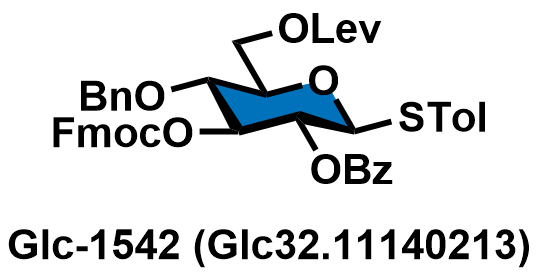
4-Methylphenyl 2-O-benzoyl-4-O-benzyl-3-O-(9-fluorenylmethoxycarbonyl)-6-O-levulinoyl-1-thio-β-D-glucopyranoside
Pricing
Request a quote

Size

Quantity

  • ISO 9001:2015 facilities · CoA + batch tracking with every shipment
  • Worldwide shipping · dry-ice option for thermolabile reagents
  • Research Use Only — not for human or veterinary clinical use

About this product

4-Methylphenyl 2-O-benzoyl-4-O-benzyl-3-O-(9-fluorenylmethoxycarbonyl)-6-O-levulinoyl-1-thio-β-D-glucopyranoside 4-Methylphenyl 2-O-benzoyl-4-O-benzyl-3-O-(9-fluorenylmethoxycarbonyl)-6-O-levulinoyl-1-thio-β-D-glucopyranoside is a strategically protected thioglycoside designed for controlled glycosylation in complex carbohydrate synthesis. This compound combines orthogonal protecting groups to enable precise sequential deprotection during oligosaccharide assembly. Structural Features Core framework : β-D-glucopyranose ring with a 4-methylphenylthio group at the anomeric position (C1), forming a stable thioglycoside donor for glycosidic bond formation. Protection pattern : Position Protecting Group Stability & Deprotection Method C2 Benzoyl ester Acid-stable; removed via alkaline hydrolysis C3 Fmoc (9-fluorenylmethoxycarbonyl) Base-labile; cleaved with 20% piperidine/DMF C4 Benzyl ether Acid-stable; removed via hydrogenolysis C6 Levulinoyl ester Acid-labile; cleaved under mild acidic conditions (pH 4.5) Key Properties Molecular formula : C₄₈H₄₅NO₉S (estimated based on substituent masses) Molecular weight : ~836.0 g/mol Physical form : White crystalline solid (typical for protected carbohydrates) Reactivity : Activatable via thiophilic promoters (e.g., NIS/TfOH) for glycosylation Electron-withdrawing benzoyl group moderates donor reactivity Synthetic Utility Orthogonal deprotection sequence : Step 1 : Fmoc removal at C3 (base) without affecting other groups Step 2 : Levulinoyl cleavage at C6 (mild acid) Step 3 : Benzoyl removal at C2 (alkaline conditions) Step 4 : Final benzyl deprotection at C4 (H₂/Pd-C) Solid-phase compatibility : Fmoc group enables use in automated synthesis platforms Levulinoyl permits temporary protection during chain elongation Branch-selective functionalization : Exposed C3/C6 hydroxyls after deprotection allow site-specific modifications Applications Glycoconjugate vaccine development : Controlled exposure of hydroxyl groups for antigen coupling Glycosidase inhibitor synthesis : Serves as a protected glucose scaffold for analog design Dendrimer construction : Enables iterative branching through sequential deprotection Stability Profile Condition Stability Acidic (pH > 3) Stable (levulinoyl intact) Basic (pH < 9) Stable except during Fmoc removal Hydrogenation Stable until final deprotection step The compound exemplifies advanced carbohydrate engineering, merging traditional protecting groups (benzyl, benzoyl) with modern orthogonal motifs (Fmoc, levulinoyl) for precision in glycan assembly. Its design allows compatibility with both solution-phase and solid-phase synthesis methodologies. Citations: https://synthose.com/products/ML822 https://patents.google.com/patent/WO2019206853A1/en https://synthose.com/products/MG340 https://patentimages.storage.googleapis.com/c4/a8/90/85cbb5f7ecd198/US7511022.pdf https://pubchem.ncbi.nlm.nih.gov/compound/1-Benzyl-4-_4-methylphenyl_-1h-1_2_3-triazole https://www.bocsci.com/product/4-methylphenyl-2-o-benzoyl-3-4-di-o-benzyl-6-o-9-fluorenylmethoxycarbonyl-339431.html https://patents.google.com/patent/WO2018053215A1/en https://www.chemicalbook.com/ProdSupplierGWCB29036383_EN.htm

You may also need