About this product
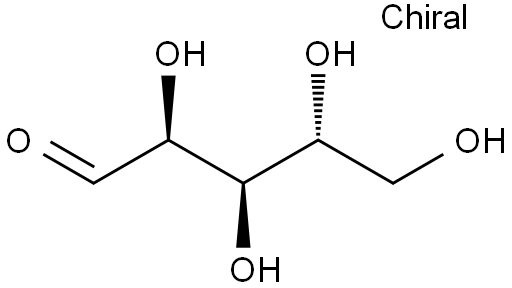
D-Arabinose
D-Arabinose (CAS No. 10323-20-3) is a monosaccharide, specifically an aldopentose, that plays a significant role in various biological processes and applications. It is characterized by its unique structure and functionality, making it valuable in food, pharmaceutical, and biotechnological industries.
Chemical Properties
Molecular Formula : C₅H₁₀O₅
Molecular Weight : 150.13 g/mol
Boiling Point : 415.5 °C at 760 mmHg
Melting Point : 156.0 to 165.0 °C
Flash Point : 155.3 °C
Appearance : Off-white powder
Optical Rotation : -105° to -110° (c=10, in H₂O)
Refractivity : -104° (C=10, H₂O)
Storage Conditions : Store at 2–8 °C for long-term stability (months).
Biological Role and Mechanism
D-Arabinose is a naturally occurring sugar found in various polysaccharides and is essential for the structure of certain biopolymers, such as hemicellulose and pectin. It serves as a substrate for fermentation processes and is involved in the metabolism of certain bacteria.
Applications
Food Industry :
Used as a low-calorie sweetener and sugar substitute in various food products, helping to reduce overall sugar content while maintaining sweetness.
Pharmaceuticals :
Acts as a building block in the synthesis of nucleosides and other bioactive compounds, playing a crucial role in drug development and medicinal chemistry.
Biotechnology :
Serves as a substrate for fermentation processes in the production of biofuels and biochemicals, promoting sustainable practices in energy production.
Research and Development :
Utilized in glycosylation reactions to create complex carbohydrates, aiding researchers in studying carbohydrate functions and interactions in biological systems.
Diagnostics :
Employed in the development of diagnostic assays for various diseases, enhancing the accuracy and efficiency of disease detection methods.
Safety Profile
D-Arabinose is generally recognized as safe when used appropriately. However, it should be handled with care due to its chemical properties.
Conclusion
D-Arabinose is a versatile monosaccharide with diverse applications across food science, pharmaceuticals, biotechnology, and research. Its ability to act as a low-calorie sweetener while also serving critical roles in biochemical processes makes it an important compound in various industries.
Citations:
https://www.chemimpex.com/products/00358
https://www.chemicalbook.com/ChemicalProductProperty_EN_CB4317320.htm
https://en.wikipedia.org/wiki/Arabinose
https://www.sigmaaldrich.com/IN/en/product/sial/10850
https://ontosight.ai/glossary/term/d-arabinose-derivatives-introduction--67a060896c3593987a4b6c8b
https://www.sigmaaldrich.com/IN/en/product/sigma/a3131
https://pubchem.ncbi.nlm.nih.gov/compound/D-_-_-Arabinose
https://www.himedialabs.com/in/grm045-d-arabinose.html