About this product
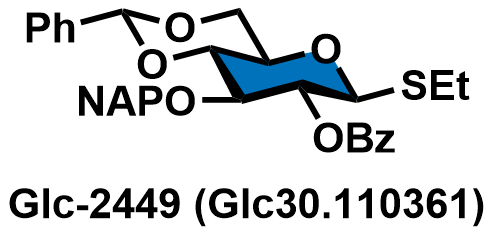
Ethyl 2- O -benzoyl-4,6- O -benzylidene-3- O -(2-naphthylmethyl)-1-thio-β-D-glucopyranoside
Ethyl 2- O -benzoyl-4,6- O -benzylidene-3- O -(2-naphthylmethyl)-1-thio-β-D-glucopyranoside is a multifunctional thioglycoside designed for controlled reactivity in stereoselective glycosylation reactions. Its protective group arrangement balances electronic and steric effects, enabling precise chemoselective coupling in oligosaccharide synthesis.
Chemical Identity
Molecular Formula : C₃₄H₃₄O₇S
Molecular Weight : ~610.75 g/mol
Key Features :
Thioethyl group at the anomeric position (enhanced stability and activation potential).
Benzoyl (electron-withdrawing) at O-2, benzylidene acetal (conformation-locking) at O-4/O-6, and 2-naphthylmethyl (bulky, electron-donating) at O-3.
Structural and Reactivity Insights
Protective Group Synergy :
4,6- O -Benzylidene : Restricts the glucopyranoside ring to a rigid chair conformation, reducing unwanted side reactions.
2- O -Benzoyl : Electron-withdrawing effect slightly disarms the donor but allows neighboring-group participation if activated.
3- O -2-Naphthylmethyl : Bulky aromatic group increases steric hindrance on the β-face, potentially enhancing α-selectivity during glycosylation.
Reactivity Profile :
The thioethyl group enables activation under mild promoters (e.g., NIS/TfOH) while maintaining stability during storage.
Combined electronic effects (electron-withdrawing benzoyl vs. electron-donating naphthylmethyl) create a balanced "semiarmed" donor, suitable for chemoselective coupling with moderately reactive acceptors.
Applications
Stereoselective Glycosylation : Used to construct α- or β-linked glycosides depending on promoter choice and acceptor reactivity. The 2-naphthylmethyl group may steer selectivity by hindering β-face nucleophilic attack.
Intermediate in Oligosaccharide Synthesis : Strategic deprotection (e.g., acidic removal of benzylidene or basic hydrolysis of benzoyl) enables sequential functionalization.
Chemoselective Strategies : Compatible with reactivity-based one-pot glycosylation methods due to intermediate donor reactivity.
Synthesis
Typical steps include:
Benzylidene acetal formation at O-4/O-6.
Benzoylation at O-2.
Naphthylmethyl ether installation at O-3 via alkylation.
Thioglycoside introduction at the anomeric center.
Physical Properties
Solubility : Hydrophobic aromatic groups favor solubility in dichloromethane, chloroform, or THF.
Stability : Crystalline solid with enhanced shelf-life due to thioglycoside and robust protective groups.
This compound exemplifies advanced protective group engineering in carbohydrate chemistry, offering tailored reactivity for synthesizing complex glycoconjugates and natural products.
Citations:
https://pmc.ncbi.nlm.nih.gov/articles/PMC5301963/
https://pmc.ncbi.nlm.nih.gov/articles/PMC2677192/
https://pmc.ncbi.nlm.nih.gov/articles/PMC2661424/
https://onlinelibrary.wiley.com/doi/10.1002/9783527618255.ch4
https://pubs.rsc.org/en/content/articlehtml/2023/ob/d3ob00817g
https://pmc.ncbi.nlm.nih.gov/articles/PMC11370891/
https://onlinelibrary.wiley.com/doi/abs/10.1002/9783527697014.ch3
https://onlinelibrary.wiley.com/doi/10.1002/ajoc.201900397