GlycoDepot
GlycoDepot

Ethyl 6-O-(2-chloroacetyl)-4-O-(9-fluorenylmethoxycarbonyl)-2-O-levulinoyl-3-O-(2-naphthylmethyl)-1-thio-β-D-glucopyranoside

Ethyl 6-O-(2-chloroacetyl)-4-O-(9-fluorenylmethoxycarbonyl)-2-O-levulinoyl-3-O-(2-naphthylmethyl)-1-thio-β-D-glucopyranoside Ethyl 6-O-(2-chloroacetyl)-4-O-(9-f…
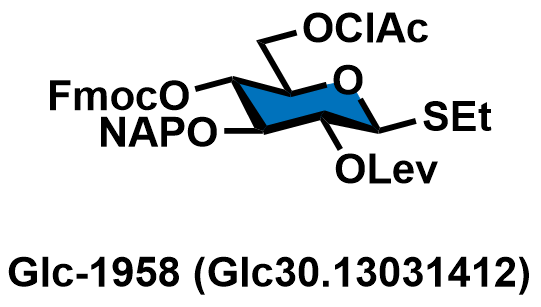
Ethyl 6-O-(2-chloroacetyl)-4-O-(9-fluorenylmethoxycarbonyl)-2-O-levulinoyl-3-O-(2-naphthylmethyl)-1-thio-β-D-glucopyranoside
Pricing
Request a quote

Size

Quantity

  • ISO 9001:2015 facilities · CoA + batch tracking with every shipment
  • Worldwide shipping · dry-ice option for thermolabile reagents
  • Research Use Only — not for human or veterinary clinical use

About this product

Ethyl 6-O-(2-chloroacetyl)-4-O-(9-fluorenylmethoxycarbonyl)-2-O-levulinoyl-3-O-(2-naphthylmethyl)-1-thio-β-D-glucopyranoside Ethyl 6-O-(2-chloroacetyl)-4-O-(9-fluorenylmethoxycarbonyl)-2-O-levulinoyl-3-O-(2-naphthylmethyl)-1-thio-β-D-glucopyranoside is a multifunctional thioglycoside engineered for precision in oligosaccharide assembly. Its design incorporates orthogonal protecting groups to enable sequential deprotection and controlled glycosylation. Structural Breakdown Core framework : β-D-glucopyranose ring with a thioethyl group at the anomeric position (C1), forming a thioglycoside donor for glycosylation reactions. Protection strategy : Position Protecting Group Key Properties C2 Levulinoyl ester Acid-labile (removable with 0.5 M hydrazine acetate or mild acid) C3 2-Naphthylmethyl ether Stable to base/acid; cleaved via hydrogenolysis C4 Fmoc (9-fluorenylmethoxycarbonyl) Base-sensitive (deprotected with 20% piperidine in DMF) C6 2-Chloroacetyl ester Nucleophilic cleavage (e.g., thiourea) with orthogonal stability to Fmoc Key Characteristics Molecular weight : ~800-850 g/mol (estimated based on substituents) Reactivity profile : Thioglycoside activation via NIS/TfOH or other thiophilic promoters Electron-withdrawing esters (levulinoyl, chloroacetyl) moderate donor reactivity compared to benzyl-protected analogs Orthogonal deprotection sequence : Fmoc (C4) → 20% piperidine Levulinoyl (C2) → pH 4.5 buffer Chloroacetyl (C6) → 0.1 M thiourea 2-Naphthylmethyl (C3) → H₂/Pd-C Synthetic Applications Solid-phase oligosaccharide synthesis : Fmoc compatibility allows integration with resin-bound strategies Levulinoyl enables temporary protection during chain elongation Branch-selective functionalization : Chloroacetyl at C6 permits post-glycosylation modifications (e.g., azide substitution) Chemoselective glycosylations : Pair with less reactive acceptors via reactivity tuning from EWG-protected positions Stability Considerations Acid sensitivity : Levulinoyl limits strong acid usage in later synthesis stages Base compatibility : Stable to mild bases (e.g., Et₃N) except during Fmoc removal Hydrogenolysis constraints : Requires late-stage deprotection of 2-naphthylmethyl to avoid early intermediate exposure This compound exemplifies modern carbohydrate engineering, combining traditional protecting groups (naphthylmethyl) with photolabile/chemoselective motifs (Fmoc, chloroacetyl) for iterative synthesis of branched glycostructures. Citations: https://pmc.ncbi.nlm.nih.gov/articles/PMC5301963/ https://pubs.rsc.org/en/content/articlehtml/2023/ob/d3ob00817g https://pmc.ncbi.nlm.nih.gov/articles/PMC2677192/ https://www.diva-portal.org/smash/get/diva2:318255/FULLTEXT01.pdf https://onlinelibrary.wiley.com/doi/abs/10.1002/9783527697014.ch3 https://pubs.acs.org/doi/10.1021/ed074p1297 https://onlinelibrary.wiley.com/doi/10.1002/9783527697014.ch5 https://par.nsf.gov/servlets/purl/10157801

You may also need