About this product
IPTG
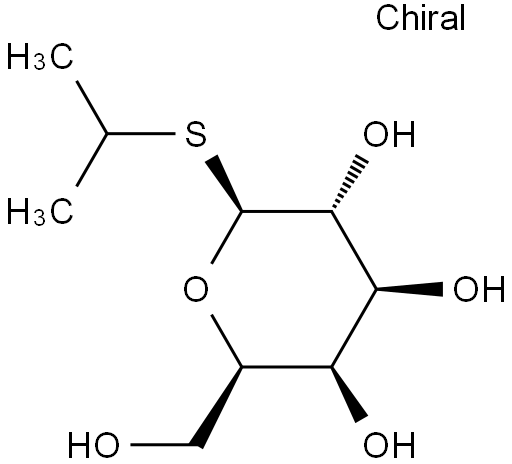
IPTG (Isopropyl β-D-1-thiogalactopyranoside) is a widely used molecular biology reagent that serves as an inducer for gene expression in systems utilizing the lac operon. Its ability to mimic allolactose, a natural lactose metabolite, allows it to activate transcription of genes under the control of the lac operator, making it an essential tool in recombinant protein production.
Chemical Properties
CAS Number : 367-93-1
MDL No. : MFCD00063273
Catalog Number : A823371
EINECS : Not available
Molecular Formula : C₉H₁₈O₅S
Molecular Weight : 238.30 g/mol
Boiling Point : 438.4 °C at 760 mmHg
Melting Point : 105 °C
Flash Point : 218.9 ± 28.7 °C
Density : Not specified (typically around 1.3329 g/cm³)
Appearance : White or white crystalline powder
Storage Conditions : Store at 2–8 °C for long-term stability (months).
Optical Rotation : -31° (c=1, water)
Refractivity : 1.5060 (estimate)
Mechanism of Action
IPTG functions as a non-hydrolyzable analog of allolactose, binding to the lac repressor protein and preventing it from attaching to the lac operator region. This action releases the repression on downstream genes, allowing for transcription and subsequent translation of proteins such as β-galactosidase. Unlike allolactose, It is not metabolized by E. coli , maintaining a consistent concentration during experiments.
Applications
Gene Expression Induction :
It is primarily used to induce protein expression in recombinant DNA systems, particularly in E. coli strains that utilize the lac operon for controlled gene expression.
Protein Purification :
It facilitates the overexpression of target proteins, which can be purified using affinity chromatography techniques, often in conjunction with tags such as His-tags.
Blue/White Screening :
IPTG is commonly used in cloning experiments alongside X-Gal to visually distinguish between recombinant and non-recombinant bacterial colonies based on color change.
Biochemical Research :
It is employed in various studies involving enzyme kinetics and metabolic pathways, aiding in understanding cellular processes and gene regulation.
Synthetic Biology :
IPTG is utilized in synthetic biology applications where precise control over gene expression is required for engineered biological systems .
Safety Profile
While IPTG is generally considered safe for laboratory use, standard safety protocols should be followed when handling this compound. Appropriate personal protective equipment (PPE) should be worn to minimize exposure.
Conclusion
IPTG (CAS No. 367-93-1) is a critical reagent in molecular biology, facilitating gene expression and protein production through its role as an inducer of the lac operon. Its unique properties make it indispensable for researchers working with recombinant proteins and genetic engineering.
Citations:
https://www.gbiosciences.com/Buffers-Reagents-Chemicals/Molecular-Biology-Related-Buffers-Chemicals/IPTG-Isopropyl-D-1-thiogalactopyranoside
https://www.chemicalbook.com/article/isopropyl-d-1-thiogalactopyranoside-iptg-a-compound-for-scientific-research.htm
https://www.chemicalbook.com/ChemicalProductProperty_EN_CB2121723.htm
https://agscientific.com/blog/iptg-facts-protocols.html
https://en.wikipedia.org/wiki/Isopropyl_%CE%B2-D-1-thiogalactopyranoside
https://www.bioline.com/iptg.html
https://www.glentham.com/en/products/product/GC6586/
https://www.nzytech.com/en/mb026-iptg/