About this product
β-Lactose
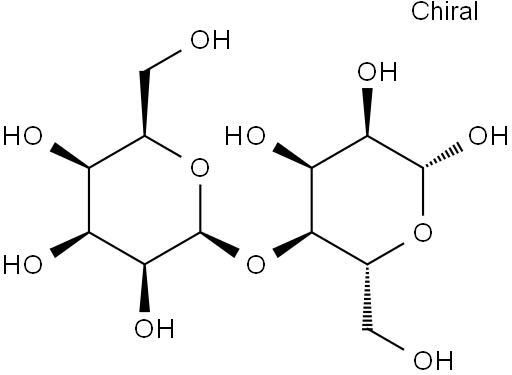
β-Lactose is a disaccharide sugar composed of one molecule of glucose and one molecule of galactose linked by a β(1→4) glycosidic bond. It is a naturally occurring sugar found in milk, particularly in bovine milk, and is known for its role in nutrition and various biochemical applications.
Chemical Properties
CAS Number : 5965-66-2
MDL No. : MFCD00064521
Catalog Number : A832404
EINECS : Not available
Molecular Formula : C₁₂H₂₂O₁₁
Molecular Weight : 342.30 g/mol
Boiling Point : 397.76 °C
Melting Point : 254 °C
Flash Point : 357.8 ± 31.5 °C
Density : 1.5900 g/cm³
Appearance : Undetermined (commonly appears as a white to off-white powder)
Storage Conditions : Store at 2–8 °C for long-term stability (months).
Physical Characteristics
β-Lactose is characterized by its white to off-white crystalline appearance and significant thermal stability, indicated by its high melting point of 254 °C and boiling point of approximately 397.76 °C. The density of 1.5900 g/cm³ suggests that it is relatively dense compared to many organic compounds.
Biological Significance
Nutritional Source :
β-Lactose is a primary carbohydrate in milk, providing energy and serving as a source of glucose and galactose for infants and other mammals.
Digestive Role :
It is hydrolyzed by the enzyme lactase into its constituent monosaccharides, which can be absorbed in the intestines. Lactase deficiency leads to lactose intolerance, where undigested lactose causes gastrointestinal discomfort.
Fermentation Substrate :
In the food industry, β-lactose is used as a substrate for fermentation processes, particularly in the production of dairy products like yogurt and cheese.
Pharmaceutical Applications :
β-Lactose serves as an excipient in pharmaceutical formulations, improving the texture and stability of tablets and capsules.
Applications
Food Industry :
Used in the formulation of dairy products, infant formulas, and as a sweetener in various food products.
Pharmaceutical Industry :
Acts as a filler or bulking agent in tablets and capsules due to its favorable properties.
Research Applications :
Utilized in studies related to carbohydrate chemistry, enzymatic activity (specifically lactase), and microbial fermentation processes.
Prebiotic Potential :
β-Lactose may have prebiotic effects, promoting the growth of beneficial gut bacteria.
Safety Profile
While β-lactose is generally recognized as safe for consumption, standard laboratory safety protocols should be followed when handling it. Personal protective equipment (PPE) such as gloves and goggles should be used to minimize exposure.
Conclusion
β-Lactose (CAS No. 5965-66-2) is an important disaccharide with significant applications in nutrition, food science, and pharmaceuticals. Its role as a primary sugar in milk makes it vital for energy provision and digestive health, while its properties make it useful in various industrial applications.
Citations:
https://www.chemicalbook.com/ChemicalProductProperty_EN_CB9684115.htm
https://www.scbt.com/p/beta-lactose-5965-66-2
https://pubchem.ncbi.nlm.nih.gov/compound/beta-Lactose
https://www.chemicalbook.com/CASEN_5965-66-2.htm
https://www.pharmaffiliates.com/en/5965-66-2-beta-lactose-pa2700362.html
https://www.glentham.com/en/products/product/GC5831/
https://www.chemeo.com/cid/44-030-9/%C2%ABbeta%C2%BB-D-Glucopyranose,%204-O-%C2%ABbeta%C2%BB-D-galactopyranosyl-
https://www.guidechem.com/dictionary/en/5965-66-2.html